
 Before
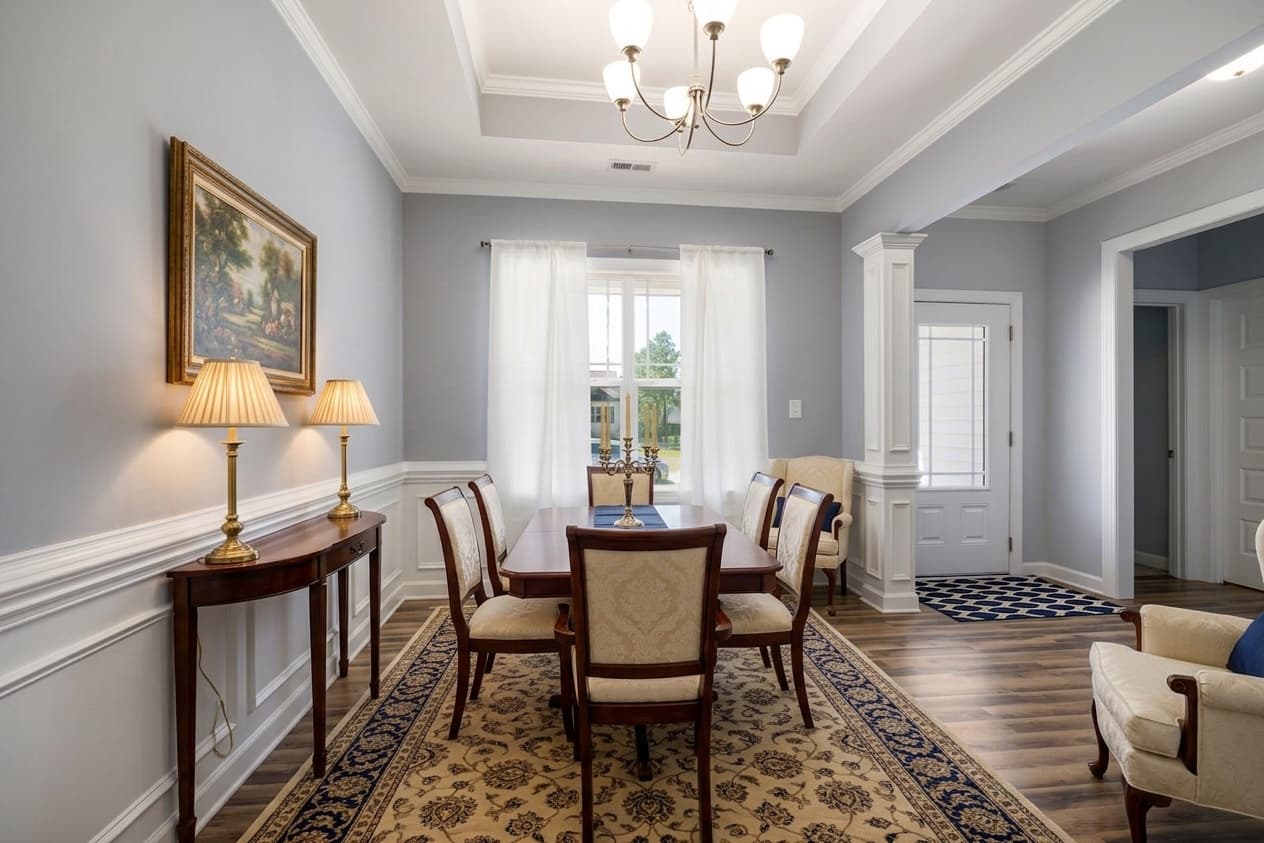 After
AfterWhat defines traditional staging
Traditional staging is defined by formality and symmetry: rolled-arm sofas, dark wood side tables and case pieces, and a warm cream-and-navy (or similar classic pairing) palette. Furniture is arranged in balanced, mirrored layouts rather than the asymmetric groupings common in modern staging.
Framed classic art (landscapes, still lifes, or simple architectural prints rather than abstract or graphic pieces) and layered window treatments reinforce the formal feel. This is the style built around "established" rather than "trendy" — it's meant to feel timeless rather than of-the-moment.
It's the most natural match for homes that already carry formal architectural detail: crown molding, chair rail, wainscoting, a defined (not open-plan) floor plan. In those homes, traditional staging isn't a style choice layered on top of the architecture — it's completing a look the house already suggests.
Which listings it suits
- Older homes — colonials, Georgians, many 1980s-2000s builder homes — with existing crown molding, wainscoting, or a formal, room-by-room (non-open-concept) floor plan.
- The $400K-$1M price band, roughly, where a sense of established quality tends to photograph better than a trend-driven design statement.
- Listings in markets or regions where traditional decor remains the dominant local taste (much of the South, parts of the Northeast) — staging that matches local taste is generally a safer bet than staging that fights it.
Avoid it on open-concept new construction or minimalist architecture, where the formal, symmetric furniture arrangement fights an architecture designed for casual flow. It also tends to be a weaker match on listings where the architecture itself is clean and unornamented, where modern, Scandinavian, or farmhouse staging is usually the safer fit.
What to check in an AI render of traditional style
Not every AI staging render nails a style consistently. Here's what to look for specifically when judging a traditional render before you publish it to the MLS:
Symmetry not actually enforced
Traditional staging relies on balanced, often mirrored furniture placement. If an AI render places traditional-style furniture in a casual, asymmetric arrangement, it undercuts the formality that defines the style — check that the layout itself, not just the furniture pieces, reads as intentional and balanced.
Art style mismatch
Abstract or graphic wall art breaks the traditional look even if the furniture is correct. Watch for framed art that reads as modern gallery-style rather than a classic countryside scene or still-life — a small detail that's easy for an AI render to get wrong since it's not explicitly furniture.
Palette drifting cool or trend-driven
The cream-and-navy (or similar warm-classic) palette is core to the style. If accent colors drift toward trend colors like sage green or terracotta, the render is blending in current design-trend training data rather than holding a genuinely traditional palette.
Try Traditional staging on your own listing
Upload a listing photo — Traditional is preselected, and the free tier gives you 6 watermarked renders a day, no signup required.
Try this Traditional lookFrequently asked questions
- Is traditional staging outdated for 2026 listings?
- No, traditional staging isn't outdated for 2026 listings — it's still the strongest match for homes with existing formal architecture and for markets where an established, classic look photographs better than a trend-driven one. "Outdated" is a mismatch problem, not a style problem: traditional staging looks wrong on the wrong house and right on the right one.
- What kind of home suits traditional staging best?
- The kind of home that suits traditional staging best: Colonials, Georgians, and homes with existing crown molding, wainscoting, or a defined (non-open-concept) floor plan — the style completes architectural detail that's already there rather than fighting it.
- Does traditional staging work on open-concept or minimalist homes?
- It tends to underperform there — the formal, symmetric furniture arrangement fights an architecture built for casual, open flow. On clean-lined, open-concept, or minimalist architecture, modern, Scandinavian, or farmhouse staging usually reads more naturally instead.
- What price range fits traditional staging?
- The price range that fits traditional staging best is roughly $400K-$1M, though the real determining factor is the home's existing architecture more than its price.